
Paper Accepted for Peer Review at Journal of Multivariate Analysis
A new manuscript on adaptive sufficient dimension reduction for ultrahigh-dimensional regression has entered the peer review pipeline.

After nearly eighteen months of development, our latest manuscript on adaptive sufficient dimension reduction for ultrahigh-dimensional regression has been submitted and accepted for formal peer review at the Journal of Multivariate Analysis. Reaching this milestone feels like closing one chapter and quietly opening another, because the real work of responding to reviewers and refining the ideas is only just beginning.
The paper grew out of a conversation I had during my second year, when a collaborator in the biology department asked what to do with a dataset that had roughly two hundred samples and more than forty thousand candidate predictors. The classical toolbox we reached for kept collapsing under the weight of that ratio, and it became clear that we needed an estimator that respected both the geometry of the response and the sparsity we suspected was hiding in the predictors.
The work introduces a refined estimator that combines sliced inverse regression with an adaptive penalty term, allowing recovery of the central subspace even when the number of predictors substantially exceeds the sample size. On the theoretical side, we establish selection consistency under mild moment conditions and derive a rate of convergence that matches the best known results in the sparse regression literature. On the empirical side, extensive simulations across synthetic and biomedical benchmarks suggest meaningful gains in both selection consistency and estimation accuracy.
One of the surprises during the project was how much the choice of slicing scheme mattered in finite samples. We spent an entire summer testing dyadic slices, quantile slices, and a data-adaptive alternative that grows the number of slices with the effective sample size. The adaptive scheme won not because it dominated in every setting, but because it was the least fragile — it rarely produced the pathological rankings we saw from the fixed schemes when the response distribution was skewed.
Preparing this submission has been a lesson in patience. Each revision surfaced a subtle question about identifiability, kernel bandwidth selection, or the practical interpretation of directions in a scientific context. I rewrote the introduction at least six times before I felt it honestly described what the method could and could not do, and the simulation section grew and shrank in equal measure as we tried to find the smallest set of experiments that told the full story.
I am grateful to my advisor and lab mates for the many whiteboard sessions that shaped the final draft, and to the two anonymous colleagues who read a late preprint and returned pages of thoughtful comments in less than a week. Writing is a solitary act, but good statistical writing is almost always a collective one.
I will share the arXiv preprint here as soon as it clears internal review. In the meantime I am preparing a short technical note for graduate students who want a gentler entry point into the framework, along with a companion notebook that walks through the estimator on a small public dataset so readers can build intuition before diving into the proofs.
Angela Owusu-Yeboah
Continue reading
More from the chronicles.
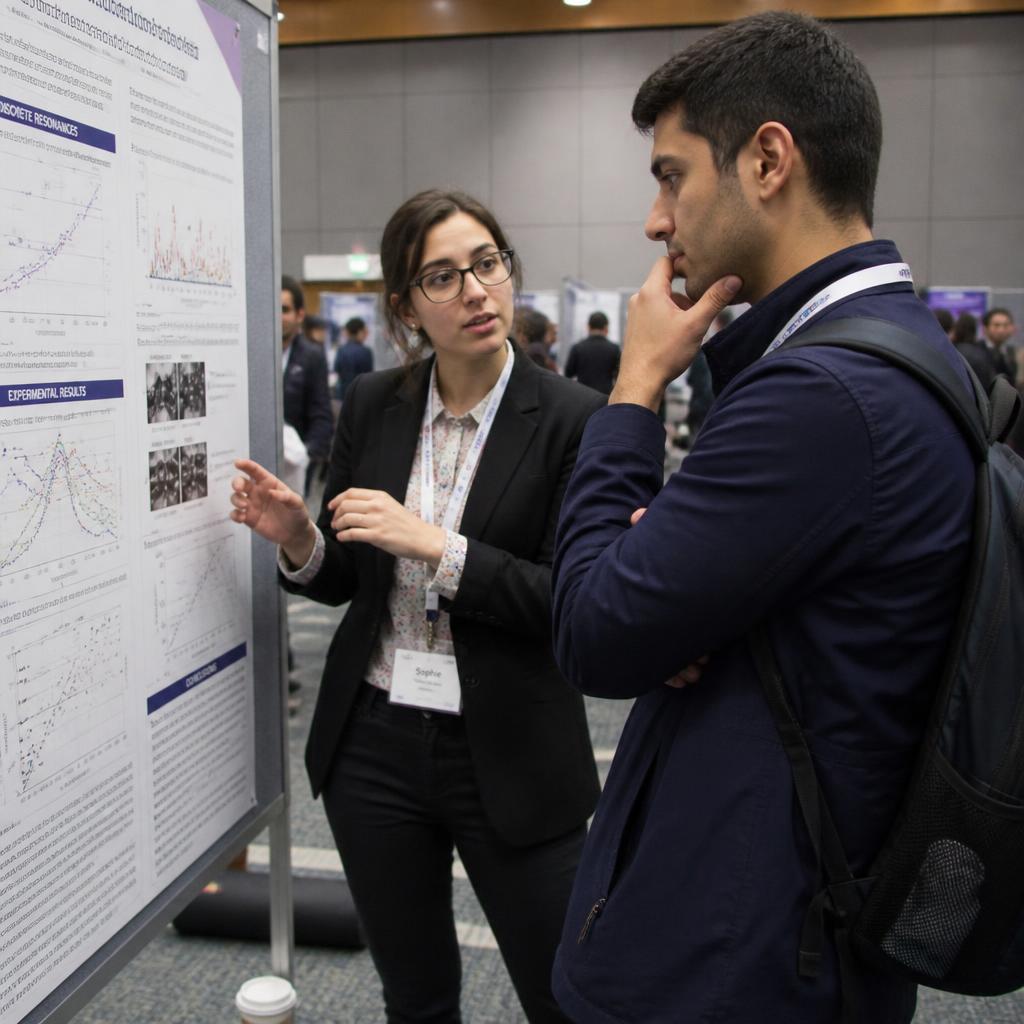
Attending the 2026 International Statistics Symposium
I will be presenting a poster on high-dimensional variable screening at the upcoming International Statistics Symposium in Kansas City.
February 12, 2026
Completed the Spring Applied Mathematics Course Curriculum
Reflections on redesigning the applied mathematics curriculum for undergraduates who do not consider themselves math people.
January 22, 2026
Nominated for the Missouri S&T Graduate Research Fellowship
Honored to receive a departmental nomination for the university-wide Graduate Research Fellowship in recognition of ongoing research productivity.
December 3, 2025